MoreExam
1. Question Content...
EXPLANATION
Answer: X - EXPLANATION Content.
Question1: What is required before an API implemented using the components of Anypoint Platform can be managed and governed (by applying API policies) on Anypoint Platform?
Question2: An organization is migrating all its Mule applications to Runtime Fabric (RTF). None of the Mule applications use Mule domain projects.Currently, all the Mule applications have been manually deployed to a server group among several customer hosted Mule runtimes.Port conflicts between these Mule application deployments are currently managed by the DevOps team who carefully manage Mule application properties files.When the Mule applications are migrated from the current customer-hosted server group to Runtime Fabric (RTF), fo the Mule applications need to be rewritten and what DevOps port configuration responsibilities change or stay the same?
Question3: An Order microservice and a Fulfillment microservice are being designed to communicate with their dients through message-based integration (and NOT through API invocations).The Order microservice publishes an Order message (a kind of command message) containing the details of an order to be fulfilled. The intention is that Order messages are only consumed by one Mute application, the Fulfillment microservice.The Fulfilment microservice consumes Order messages, fulfills the order described therein, and then publishes an OrderFulfilted message (a kind of event message). Each OrderFulfilted message can be consumed by any interested Mule application, and the Order microservice is one such Mute application.What is the most appropriate choice of message broker(s) and message destination(s) in this scenario?
Question4: An integration Mute application consumes and processes a list of rows from a CSV file. Each row must be read from the CSV file, validated, and the row data sent to a JMS queue, in the exact order as in the CSV file.If any processing step for a row falls, then a log entry must be written for that row, but processing of other rows must not be affected.What combination of Mute components is most idiomatic (used according to their intended purpose) when Implementing the above requirements?
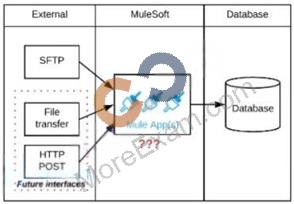
Question5: Refer to the exhibit.A business process involves the receipt of a file from an external vendor over SFTP. The file needs to be parsed and its content processed, validated, and ultimately persisted to a database. The delivery mechanism is expected to change in the future as more vendors send similar files using other mechanisms such as file transfer or HTTP POST.What is the most effective way to design for these requirements in order to minimize the impact of future change?
Question6: A Mule application is synchronizing customer data between two different database systems.What is the main benefit of using XA transaction over local transactions to synchronize these two database system?
Question7: An organization has decided on a cloudhub migration strategy that aims to minimize the organizations own IT resources. Currently, the organizational has all of its Mule applications running on its own premises and uses an premises load balancer that exposes all APIs under the base URL https://api.acme.com As part of the migration strategy, the organization plans to migrate all of its Mule applications and load balancer to cloudhub What is the most straight-forward and cost effective approach to the Mule applications deployment and load balancing that preserves the public URLs?
Question8: An API has been unit tested and is ready for integration testing. The API is governed by a Client ID Enforcement policy in all environments.What must the testing team do before they can start integration testing the API in the Staging environment?
Question9: A Mule application uses the Database connector.What condition can the Mule application automatically adjust to or recover from without needing to restart or redeploy the Mule application?
Question10: Refer to the exhibit.A Mule application is being designed to be deployed to several CIoudHub workers. The Mule application's integration logic is to replicate changed Accounts from Satesforce to a backend system every 5 minutes.A watermark will be used to only retrieve those Satesforce Accounts that have been modified since the last time the integration logic ran.What is the most appropriate way to implement persistence for the watermark in order to support the required data replication integration logic?
Question11: A mule application is being designed to perform product orchestration. The Mule application needs to join together the responses from an inventory API and a Product Sales History API with the least latency.To minimize the overall latency. What is the most idiomatic (used for its intended purpose) design to call each API request in the Mule application?
Question12: A set of integration Mule applications, some of which expose APIs, are being created to enable a new business process. Various stakeholders may be impacted by this. These stakeholders are a combination of semi-technical users (who understand basic integration terminology and concepts such as JSON and XML) and technically skilled potential consumers of the Mule applications and APIs.What Is an effective way for the project team responsible for the Mule applications and APIs being built to communicate with these stakeholders using Anypoint Platform and its supplied toolset?
Question13: A team would like to create a project skeleton that developers can use as a starting point when creating API Implementations with Anypoint Studio. This skeleton should help drive consistent use of best practices within the team.What type of Anypoint Exchange artifact(s) should be added to Anypoint Exchange to publish the project skeleton?
Question14: An organization's governance process requires project teams to get formal approval from all key stakeholders for all new Integration design specifications. An integration Mule application Is being designed that interacts with various backend systems. The Mule application will be created using Anypoint Design Center or Anypoint Studio and will then be deployed to a customer-hosted runtime.What key elements should be included in the integration design specification when requesting approval for this Mule application?
Question15: What requires configuration of both a key store and a trust store for an HTTP Listener?
Question16: An organization currently uses a multi-node Mule runtime deployment model within their datacenter, so each Mule runtime hosts several Mule applications. The organization is planning to transition to a deployment model based on Docker containers in a Kubernetes cluster. The organization has already created a standard Docker image containing a Mule runtime and all required dependencies (including a JVM), but excluding the Mule application itself.What is an expected outcome of this transition to container-based Mule application deployments?
Question17: An integration Mule application is deployed to a customer-hosted multi-node Mule 4 runtime duster. The Mule application uses a Listener operation of a JMS connector to receive incoming messages from a JMS queue.How are the messages consumed by the Mule application?
Question18: What comparison is true about a CloudHub Dedicated Load Balancer (DLB) vs. the CloudHub Shared Load Balancer (SLB)?
Question19: In Anypoint Platform, a company wants to configure multiple identity providers(Idps) for various lines of business (LOBs) Multiple business groups and environments have been defined for the these LOBs. What Anypoint Platform feature can use multiple Idps access the company's business groups and environment?
Question20: An API client is implemented as a Mule application that includes an HTTP Request operation using a default configuration. The HTTP Request operation invokes an external API that follows standard HTTP status code conventions, which causes the HTTP Request operation to return a 4xx status code.What is a possible cause of this status code response?
Question21: What metrics about API invocations are available for visualization in custom charts using Anypoint Analytics?
Question22: An external REST client periodically sends an array of records in a single POST request to a Mule application API endpoint.The Mule application must validate each record of the request against a JSON schema before sending it to a downstream system in the same order that it was received in the array Record processing will take place inside a router or scope that calls a child flow. The child flow has its own error handling defined. Any validation or communication failures should not prevent further processing of the remaining records.To best address these requirements what is the most idiomatic(used for it intended purpose) router or scope to used in the parent flow, and what type of error handler should be used in the child flow?
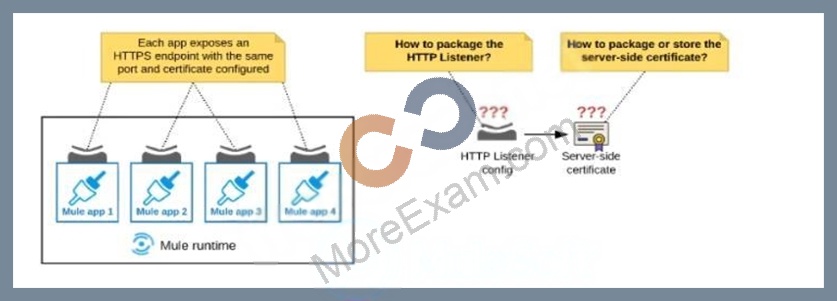
Question23: Refer to the exhibit.An organization deploys multiple Mule applications to the same customer -hosted Mule runtime. Many of these Mule applications must expose an HTTPS endpoint on the same port using a server-side certificate that rotates often.What is the most effective way to package the HTTP Listener and package or store the server-side certificate when deploying these Mule applications, so the disruption caused by certificate rotation is minimized?
Question24: A mule application is deployed to a Single Cloudhub worker and the public URL appears in Runtime Manager as the APP URL.Requests are sent by external web clients over the public internet to the mule application App url. Each of these requests routed to the HTTPS Listener event source of the running Mule application.Later, the DevOps team edits some properties of this running Mule application in Runtime Manager.Immediately after the new property values are applied in runtime manager, how is the current Mule application deployment affected and how will future web client requests to the Mule application be handled?
Question25: What aspect of logging is only possible for Mule applications deployed to customer-hosted Mule runtimes, but NOT for Mule applications deployed to CloudHub?
Question26: An organization is designing the following two Mule applications that must share data via a common persistent object store instance:- Mule application P will be deployed within their on-premises datacenter.- Mule application C will run on CloudHub in an Anypoint VPC.The object store implementation used by CloudHub is the Anypoint Object Store v2 (OSv2).what type of object store(s) should be used, and what design gives both Mule applications access to the same object store instance?
Question27: An organization is evaluating using the CloudHub shared Load Balancer (SLB) vs creating a CloudHub dedicated load balancer (DLB). They are evaluating how this choice affects the various types of certificates used by CloudHub deplpoyed Mule applications, including MuleSoft-provided, customer-provided, or Mule application-provided certificates.What type of restrictions exist on the types of certificates that can be exposed by the CloudHub Shared Load Balancer (SLB) to external web clients over the public internet?
Question28: A Mule application is deployed to a cluster of two(2) cusomter-hosted Mule runtimes. Currently the node name Alice is the primary node and node named bob is the secondary node. The mule application has a flow that polls a directory on a file system for new files.The primary node Alice fails for an hour and then restarted.After the Alice node completely restarts, from what node are the files polled, and what node is now the primary node for the cluster?